Tadalafil trial withdrawals: reading the count and the denominator
Five questions help distinguish a reported symptom, a person who leaves, and the evidence needed for a treatment conversation.
Published and source checked · 11 minute read
A safety chart invites an immediate comparison: which bar is shorter? Before making that comparison, read the noun attached to the number. An episode, a person with a symptom, and a person who stops treatment are different things to count. A graph can be accurate while answering a narrower question than the reader has in mind.
This analysis uses the daily tadalafil study as a starting point for five reading tasks: identify the outcome, locate its denominator, examine the comparison, describe uncertainty, and formulate a useful question. The chart carries the published counts. The worked examples below are explicitly hypothetical exercises in interpretation, not additional trial results or accounts of individual patients.
Reading the evidence
- Name the outcome
- Write down exactly what makes a person enter the numerator.
Sources: Porst 2006
- Locate the denominator
- Ask who had an opportunity to contribute the counted outcome.
Sources: Porst 2006
- Separate decisions from experiences
- A record of leaving does not describe every experience preceding that decision.
Sources: Porst 2006
- Describe what remains unknown
- A precise-looking count does not supply an interval, a causal explanation, or a personal forecast.
Sources: Porst 2006
- Bring a focused question
- Ask which additional record would change the interpretation you are considering.
Sources: Porst 2006
The count needs both its outcome definition and its group denominator.
These counts do not measure every symptom or prove treatment causation. Historical daily arms are not dosing advice.
Sources: Porst 2006
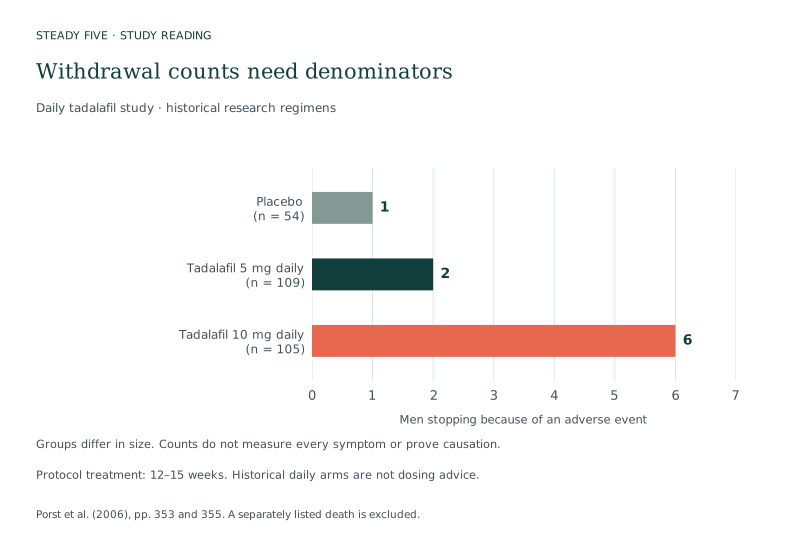
| Historical research arm | Stopped for an adverse event | Randomized men |
|---|---|---|
| Placebo | 1 | 54 |
| Tadalafil 5 mg daily | 2 | 109 |
| Tadalafil 10 mg daily | 6 | 105 |
Start with the record being counted
Safety assessment included every randomized man and considered events appearing or worsening afterward. A renal-cell-carcinoma death was recorded separately; the investigator judged it unrelated to treatment. Lilly ICOS sponsored the research. Company author affiliations, Lilly statistical analysis, and Lilly writing support were disclosed.
The reading problem is to distinguish four questions: did something happen, did it change, was it attributed to treatment, and did it lead to a decision to leave? These questions can describe the same sequence without having the same answer. Writing them as separate columns prevents a single word such as safety from absorbing several different judgments. A completed column is evidence about that particular question; it does not automatically fill the others.
For a hypothetical record, imagine an observation dated Monday and a departure dated Friday. Their order establishes that one came first. It does not, by itself, establish why the departure occurred. A reason field adds information, but interpreting that field still requires knowing what the category means. This is a way to read documentation, not a reconstruction of unreported decisions in the study.
Sources: Porst 2006
Count people without counting them twice
Consider a fictional exercise involving twelve records. Four contain a headache entry, three contain a nausea entry, and two appear in both lists. Adding the two lists produces seven entries, but only five different people appear: four plus three minus the two counted twice. This arithmetic says nothing about the frequency of either symptom in the tadalafil study. Its purpose is to show why adding categories can change the unit of a summary.
Now imagine that the same fictional records contain a separate column for whether someone left. A person might appear in both symptom lists and also in that column. Combining all three columns would mix experiences with a subsequent decision, while counting some people repeatedly. A reader needs the relationship between the lists before constructing a total. The existence of separate rows is not evidence that their members are mutually exclusive.
A useful practical exercise is to mark each heading as people, episodes, or decisions before reading its values. Then ask whether overlap is permitted. Our guide to preparing a follow-up when an ED option disappoints offers a place to organize the questions that remain. The interpretation here concerns record structure; it does not prescribe how someone should respond to a symptom.
| Fictional record set | Entries shown | Interpretive step |
|---|---|---|
| Headache list | 4 people | Keep its own definition |
| Nausea list | 3 people | Check overlap with the first list |
| Present in both lists | 2 people | Subtract the duplicate count once |
| Either list | 5 unique people | 4 + 3 − 2, not a trial estimate |
Sources: Porst 2006
Separate repeated events from separate participants
An event count can grow without anyone new entering the group. In another invented example, one person records three episodes and another records one. There are four episodes and two people with an episode. If only the first person subsequently leaves, there is also one departure. None of these totals contradicts the others. Each answers a different question about the same fictional records.
This distinction matters when a narrative moves between phrases such as many reports and many participants. The first could describe repeated observations from a few people. The second requires a count of distinct individuals. A graph needs a clear unit because its visual shape cannot reveal which counting rule produced it. Even a carefully labeled bar leaves recurrence unanswered unless the underlying summary actually describes recurrence.
A useful check is to ask whether the count would change if one existing participant reported another episode. An episode count could rise; a count of people with any episode would not necessarily rise. A count of people leaving depends on a different event again. This thought experiment identifies the question without inventing missing data. It also shows why personal experience cannot be reconstructed by dividing a total evenly among everyone in a group.
Sources: Porst 2006
Read the group size beside the bar
Imagine three departures in a fictional group of thirty and three in a separate group of ninety. The counts match, but the proportions are ten percent and approximately 3.3 percent. A raw tally tells how many records met the rule. A proportion relates that tally to a defined group. Neither description should be selected merely because it makes a visual difference look more impressive.
The denominator must belong to the outcome being discussed. A questionnaire might have a different set of available records from a participation log. Borrowing one denominator for the other would answer a newly constructed question, even if both numbers appeared in the same paper. The reading task is therefore to trace the numerator and denominator together, rather than treat every reported group size as interchangeable.
A proportion also needs a period of observation and a sufficiently clear membership rule. Without those details, two identical percentages might summarize different opportunities for an outcome to occur. Keep the definition of the regimen separate from this arithmetic. The guide to comparing daily and as-needed plans provides related reading for that conversation; it does not convert a group proportion into an instruction for an individual.
Sources: Porst 2006
Ask what connects an experience to leaving
A departure combines an experience with a decision. To see why that matters, invent two recordkeeping exercises with the same reported discomfort. In one exercise, the person remains under observation; in the other, the person leaves. A departure tally differs even though the initial experience is described identically. This is a logical example, not a claim about the investigators’ rules or participants’ motivations.
Several questions would be needed to understand the difference. What did the person report? When was the report recorded? What reason was assigned to the departure? Was more than one reason possible? A category can be useful without preserving every detail of the decision. Conversely, a long narrative may describe an experience vividly without providing a consistent rule that could be applied across a group.
For an editorial comparison of care arrangements, the corresponding question concerns documentation: where would a person find the process for reporting a problem and requesting follow-up? The Ro tadalafil review can be used to examine the service terms documented there. That link does not connect a provider to the trial’s outcomes. A service arrangement and a clinical study need separate evidence, even when both use the same medicine’s name.
Sources: Porst 2006
Keep symptom intensity and consequences separate
An outcome can be described along several dimensions: how strongly it was experienced, what consequences followed, what care was needed, and whether participation ended. These dimensions need not move together. A departure field alone cannot reconstruct the intensity of the preceding symptom. Likewise, a description of intensity does not supply the full account of subsequent care or establish the reason for leaving.
The table below is an editorial worksheet, not a replacement for formal clinical classifications. Its purpose is to show the type of record needed for each question. Keeping the questions separate helps prevent a reader from assuming that every departure was medically severe, or that remaining in a study necessarily meant an absence of troublesome experiences. Neither conclusion follows from participation status alone.
This distinction also improves questions about ongoing support. A review of Hims tadalafil documentation can help organize what to check about contact and follow-up terms. The useful comparison is whether the relevant process is described clearly. It is not an inference that a particular service changes symptom severity, prevents complications, or reproduces a study’s findings. Those would require evidence of their own.
| Question | Record needed | What a departure count leaves open |
|---|---|---|
| How intense was it? | A description or defined intensity measure | The strength of the experience |
| What happened afterward? | Dated consequences and care records | The sequence after the report |
| Why did participation end? | The recorded reason and category rules | Other experiences or contributing considerations |
| Was treatment responsible? | Evidence supporting an attribution assessment | A causal explanation from timing alone |
Sources: Porst 2006
Notice how sensitive a small tally can be
In a hypothetical group of fifty, one departure represents two percent and two departures represent four percent. One additional observation doubles the percentage while changing the absolute proportion by two percentage points. Both descriptions are arithmetically correct. The example illustrates sensitivity to a small change in the underlying records; it is not an uncertainty calculation for the published trial.
A reader should therefore distinguish precision of counting from precision of estimation. A total can be recorded as an exact integer while leaving substantial questions about what would happen in another group. The first concerns the observed records. The second concerns inference beyond them. More decimal places in a calculated percentage do not create more information about that second question.
An uncertainty interval or a statistical comparison requires a defined calculation and assumptions. Drawing an interval by eye, or treating visibly unequal bars as a completed statistical test, supplies neither. A useful annotation can instead state the limit of the available description. This is not a reason to ignore the observations. It is a reason to describe exactly what they establish before using them to make a wider claim.
Sources: Porst 2006
Place the observations on a calendar
Counts need a time window. Imagine identical fictional groups observed for two weeks and twelve weeks. Even with an otherwise consistent counting rule, they have different calendar opportunities to accumulate reports. Comparing their totals as though the observation periods matched would leave an important difference unexplained. This example does not imply that outcomes increase at a constant rate or that a longer period can be rescaled with simple multiplication.
Actual observation time adds another question. If some people leave early, the maximum planned duration is not the time contributed by every person. Calculating person-time would require records of how long each person was observed under the relevant definition. A group size multiplied by the scheduled maximum can therefore be an assumption rather than a measurement. A final tally does not reveal departure dates.
The companion analysis of sildenafil extension participation offers another setting in which to practice identifying the observation question. Its findings should not be placed beside this chart to create a drug ranking. First ask whether outcome definitions, participants, treatment circumstances, and time windows support the comparison being proposed. A shared clinical topic is only the beginning of that assessment.
Sources: Porst 2006
Keep benefit questions beside safety questions
A benefit measure and a departure measure can describe different dimensions of a decision. Consider a hypothetical grid with improvement on one axis and leaving on the other. Its four cells allow improvement with continued participation, improvement followed by departure, no improvement with continued participation, and no improvement followed by departure. The grid makes no claim about the distribution of trial participants. It simply shows why the two questions are not interchangeable.
To populate such a grid from real research would require compatible individual records and clear definitions for both axes. Separate totals do not necessarily reveal how many people belong in each cell. Guessing the overlap could create an apparently persuasive balance of benefits and harms that the available summary does not actually contain. Keeping an empty cell marked unknown is more informative than filling it with an assumption.
A broader treatment judgment may also involve outcomes that were never measured, experiences occurring after observation ended, or concerns relevant to a particular person. Naming these questions does not establish that an unmeasured problem occurred. It defines the boundary between the evidence at hand and the evidence a wider judgment would require. That boundary should remain visible when a concise chart is used in a longer conversation.
Sources: Porst 2006
Bring the five questions to the treatment conversation
A practical reading note can fit on five lines: the counted outcome, the relevant people, the comparison, the remaining uncertainty, and the next question. Write a specific noun on each line. A request to clarify how an outcome was defined is easier to answer than a general request to declare a medicine safe. This worksheet organizes a discussion; it does not determine whether someone should start, continue, change, or stop a prescription.
Current CIALIS daily ED labeling starts at 2.5 mg and may increase to 5 mg, unlike historical 10 mg daily research. Nitrates and guanylate cyclase stimulators are contraindicated. Clinicians assess cardiovascular status, kidney or liver conditions, and interacting medicines. An erection lasting over four hours requires emergency care. Sudden vision loss or hearing decrease/loss requires stopping treatment and prompt medical attention. These are label boundaries, not individual dosing instructions.
Use the interaction questions guide to organize what needs medical review. Compounded medicines are not FDA-approved and do not undergo FDA premarket review for safety, effectiveness, or quality. The compounded-products guide develops that separate formulation question. An ingredient name is not a substitute for identifying the exact product and its evidence. The final conversation should keep study interpretation, current prescribing information, and documentary service terms connected without treating them as the same source of knowledge.
Sources: Porst 2006; Cialis label; FDA compounding guidance
Questions about the evidence
Can a person report an improvement and still leave?
Yes, those descriptions are logically compatible. Improvement describes one outcome; leaving describes a decision or participation event. An individual record would be needed to explain how they relate in a particular case. Separate group totals do not reveal that overlap, and this possibility is not a claim about any participant in the study.
Sources: Porst 2006
Would identical departure counts mean identical experiences?
No. Equal totals can arise from different group sizes, observation periods, episodes, and recorded reasons. To judge similarity, first specify which aspect of experience matters. Matching one tally is evidence of equality for that tally, not a complete description of what happened to everyone contributing to it.
Sources: Porst 2006
Does a percentage automatically make a comparison fair?
A percentage makes the denominator explicit when it is reported properly. It does not resolve differences in outcome definitions or observation opportunities. A comparison still needs a clear account of who was included, what was counted, and when the counting occurred. Converting a number does not settle those design questions.
Sources: Porst 2006
Why not estimate the missing timing from the final total?
Many different sequences can end with the same total. Departures early in observation and departures near its end could produce an identical final tally. Without timing records, choosing one sequence would add information that was never observed. The appropriate question is whether the necessary dated records are available.
Sources: Porst 2006
What is the most useful question to take away?
Ask what additional evidence would change your interpretation. That might be a clearer outcome definition, an explanation of a denominator, or a documented follow-up process. The answer should identify a missing piece of information rather than turn a study summary into a personal recommendation or a ranking of services.
Sources: Porst 2006
Editorial assessment
Our editorial assessment is that a withdrawal chart is most useful when it prompts precise questions. Name the counted event, keep its denominator attached, examine the comparison structure, and distinguish the observed record from the inference being considered. Then identify the information needed for the next decision. This approach makes the chart usable without asking it to supply a complete account of symptoms, treatment causation, personal suitability, or the quality of a prescribing service.
Sources and access
- Oral sildenafil in the treatment of erectile dysfunction. Sildenafil Study Group.
Relevant methods, results and funding passages inspected in a retained full-text primary article.
Checked 2026-10-25.
- Evaluation of the efficacy and safety of once-a-day dosing of tadalafil 5mg and 10mg in the treatment of erectile dysfunction: results of a multicenter, randomized, double-blind, placebo-controlled trial.
Relevant methods, results and funding passages inspected in a retained full-text primary article.
Checked 2026-10-25.
- VIAGRA (sildenafil citrate) US prescribing information
Current official prescribing information inspected.
Checked 2026-10-25.
- Cialis (tadalafil) prescribing information
Current official prescribing information inspected.
Checked 2026-10-25.
- Understanding the risks of compounded drugs
Official FDA guidance inspected.
Checked 2026-10-25.