Sildenafil follow-up: the meaning of finishing a study
A practical reading of participation records, withdrawal categories and the questions that need a different kind of evidence.
Published and source checked · 11 minute read
Finishing a study sounds like a simple outcome. The difficulty begins when a reader quietly replaces that outcome with something more personal: feeling better, avoiding every unwanted effect or finding the right treatment. A continuation record can be useful without answering all those questions. Reading it carefully starts with deciding which question the record was built to answer.
This guide uses the sildenafil extension report as a starting point for five reading tasks: naming the outcome, identifying the people, examining the comparison, locating uncertainty and preparing a precise follow-up question. The accompanying figure contains the reported participation counts. The examples below are deliberately invented to explain the reasoning; they are not reconstructed patient histories or additional results from the research.
Reading the evidence
- Name the outcome
- Write down exactly what earns a person a place in the counted category.
Sources: Goldstein 1998
- Identify the people
- Read the denominator as a description of a group, not merely the number below a fraction.
Sources: Goldstein 1998
- Locate the comparison
- Ask what observation would represent the alternative experience during the same period.
Sources: Goldstein 1998
- Keep unknowns visible
- An uncollected answer should remain unknown rather than becoming an assumed success or failure.
Sources: Goldstein 1998
- Prepare the next question
- Separate questions about symptoms, study participation and service arrangements before seeking an explanation.
Sources: Goldstein 1998
The chart separates finishing follow-up from the recorded reasons for leaving it.
Completion is not an erectile-response measure or a comparison with placebo.
Sources: Goldstein 1998
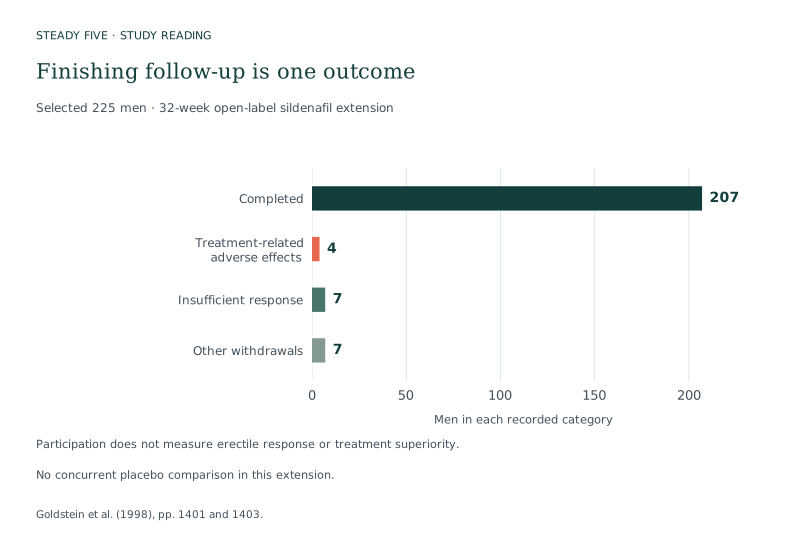
| Recorded outcome | Men | Status |
|---|---|---|
| Completed | 207 | Completed |
| Treatment-related adverse effects | 4 | Withdrew |
| Insufficient response | 7 | Withdrew |
| Other withdrawals | 7 | Withdrew |
Start with the record being counted
The extension admitted men who finished the preceding randomized flexible-dose trial without serious adverse effects. It openly gave sildenafil without a concurrent placebo group. Completion described participation, and adverse effects caused some withdrawals. Pfizer funded the work; clinical authors reported consulting, and an author listed a Pfizer affiliation.
Our interpretive task is to keep a record and its meaning together. Imagine a file with separate boxes for attending a final appointment, returning a questionnaire, taking a medicine and reporting satisfaction. Checking one box would not logically check the others. A useful summary therefore needs a noun after the number: appointments attended, forms returned, people satisfied or another precisely defined outcome.
Before asking whether a finding sounds encouraging, translate its heading into an ordinary sentence about what was observed. Then write the question you actually want answered beside it. The gap between those sentences identifies the information still needed. Our guide to what an ED evaluation should clarify provides a place to organize personal questions without making a research category stand in for a clinical assessment.
Sources: Goldstein 1998
A denominator tells you which question was asked
Consider an invented outreach program: 120 people receive invitations, 90 start and 72 finish. Dividing 72 by 90 gives 80 percent of starters. Dividing the same 72 by 120 gives 60 percent of invitees. Both calculations are correct, but their sentences describe different groups. Neither calculation says whether the program improved the outcome that originally interested those people.
This is a conditional question: among people who reached a particular stage, what happened next? The condition belongs in the answer. Removing it can make a statement sound more widely applicable without adding any observations. A denominator also carries the entry rules, setting and point in the process at which the group was defined. Those features cannot be recovered from a percentage alone.
A practical reading habit is to circle the phrase after “among.” If that phrase is absent, look for the enrollment or analysis description before interpreting the result. Keep other groups on separate lines. People invited, eligible, enrolled and measured may answer related questions, but replacing one group with another changes the question rather than improving the arithmetic.
Sources: Goldstein 1998
Completion and improvement need separate columns
Here is another explicitly hypothetical record. Ten people finish a follow-up project. Six meet an invented improvement rule and four do not. Two people who leave before its final appointment nevertheless report improvement earlier. In this imagined example, completing the project and improving overlap, but neither category contains the other. Knowing one total would not let a reader reconstruct the second.
The lesson is about the information structure. To connect two outcomes, a reader needs a record showing how they occur in the same people. Two separate totals can hide different patterns of overlap. A table with one row per person and a separate column for each outcome would help answer that question; a single continuation total would leave the relationship unresolved.
The following invented worksheet distinguishes the observations without assigning them a value judgment. A completed form is useful evidence that a form was returned. A reported improvement is useful evidence of that report. Neither becomes a complete account of someone’s experience merely because it is easy to summarize. Choosing the appropriate column is part of defining the question before counting.
| Record field | What a yes entry establishes | What remains unanswered |
|---|---|---|
| Final form returned | The form was received | Whether the person felt better |
| Improvement reported | A report of improvement was recorded | Whether follow-up was completed |
| Follow-up completed | The completion rule was met | Whether every intended outcome improved |
Sources: Goldstein 1998
The comparison belongs to a particular period
Imagine a hypothetical experiment assigning people by a coin toss to approach A or approach B. After the initial observation period, participants can volunteer for a new phase in which everyone receives A. The original assignments still describe what happened earlier. They do not create a group receiving B during the later phase simply because the people once belonged to two groups.
A comparison must connect an outcome, a group and a period. If one of those changes, the reader needs to reconsider the question being estimated. Asking what happened during continued observation differs from asking what would have happened under the alternative. The first question can produce useful descriptive records while leaving the second unresolved. Calling an observation descriptive does not make it unimportant.
Draw a short timeline when a paper moves between phases. Mark the treatments or procedures being compared at each point and identify when the outcome was collected. Avoid carrying a label from the first phase across the entire timeline without checking its meaning. Our companion analysis of daily tadalafil trial withdrawals examines another outcome definition; it is a separate reading exercise rather than a basis for ranking the drugs.
Sources: Goldstein 1998
Knowing the treatment raises a different question
In a hypothetical unblinded project, participants and researchers know the approach being used. That knowledge could matter when interpreting an experience, deciding to attend another visit or describing a change. These are possible pathways to consider, not proof that expectations caused any particular observation. An explanation remains a hypothesis until there is evidence that distinguishes it from alternatives.
Time introduces a separate set of possibilities. An imagined participant’s circumstances might change between the beginning and the end of observation, even if the assigned approach stays the same. A before-and-after account therefore joins the treatment experience to everything else occurring during that interval. Without additional information, the account cannot separate those contributions merely by placing the observations in chronological order.
The useful question is what comparison could help distinguish the explanations. Concurrent groups observed through comparable procedures can address a different question from a narrative about one group over time. The strength of an interpretation depends on that structure, not on how confidently a chart is drawn. Keep a list of plausible alternatives beside the claim and ask which, if any, the design helps resolve.
Sources: Goldstein 1998
A reason for leaving is a classification
Imagine a project that asks departing participants to select one reason from a short list. A person might have several concerns but choose the one that best fits the available wording. Another person might choose the same category for a different combination of concerns. The resulting label identifies a recorded classification; it does not automatically supply the full story behind the decision.
This thought experiment illustrates why category names deserve careful reading. Ask whether the record counts people, decisions or separate reasons; whether more than one response was allowed; and whether the categories exhaust the possibilities. If those details are unavailable, leave them open. Do not create a detailed narrative from a broad category simply because that narrative seems plausible.
The original interpretation table below focuses on the next record needed. Its categories are invented examples, not a recoding of the trial. Notice that a reason for leaving does not count everyone who ever experienced the same concern. Someone may have a concern and remain, or leave for a reason unrelated to that concern. A decision category and an experience category require separate definitions.
| Invented recorded decision | Narrow reading | Further record needed |
|---|---|---|
| Could not attend | Attendance was given as a reason | Which appointment and what prevented attendance |
| Outcome fell short | An unmet expectation was recorded | Which outcome and how it was assessed |
| Preferred another arrangement | A preference was reported | What alternatives were considered |
Sources: Goldstein 1998
The same final count can conceal different timing
Imagine two groups of twenty people followed for twelve weeks. Each has four departures. In one invented group, all four occur during the first week; in the other, all occur during week ten. The final tally matches, while the histories are different. A column containing only the total cannot reveal which sequence occurred.
A time-to-event display needs more than a starting count and a final count. It needs information about when events occurred and how long each person remained under observation. The calendar duration printed in a study heading is not a substitute for those individual records. Likewise, dividing a total by the longest possible observation period does not reconstruct the time contributed by every participant.
This distinction helps sharpen a follow-up question. Instead of asking only whether something happened, specify whether the timing, persistence or sequence matters to your concern. Our guide to preparing a better follow-up when an option disappoints can help organize that conversation. Keeping dates and the meaning of each observation separate is more informative than treating a final total as a complete timeline.
Sources: Goldstein 1998
Unknown answers should stay visibly unknown
A record saying that someone left a project can coexist with no later symptom questionnaire. Those are two different facts about the record: a known participation decision and an absent outcome measurement. Filling the empty outcome cell with “improved” would add an assumption. Filling it with “did not improve” would also add an assumption. Neither choice becomes an observation through repetition.
For a hypothetical spreadsheet, use distinct entries for yes, no and unknown. That small design choice prevents missing information from being quietly counted as a negative answer. It also makes the next research question clearer: could later information be collected, and would it answer the same question in a comparable way? Availability of a record and its meaning both matter.
Service documentation can be approached with similar discipline. A description of how follow-up is requested is not evidence of a patient outcome. When reading the Ro sildenafil review, use it to identify documentary questions about contact and continuing care, then verify the current terms. That administrative reading exercise supplies no missing clinical observations and should not be used to fill gaps in a trial record.
Sources: Goldstein 1998
Turn a broad concern into an answerable question
An original five-part worksheet can make a conversation more precise. Write the outcome you care about, the observation period, what was actually recorded, the reason a change was considered and the remaining question. Each field has a different job. A symptom description cannot replace a date, and a date cannot explain a person’s reason for changing an arrangement.
For an invented example, someone might write “confidence during planned intimacy” as the desired outcome and “a note after each relevant occasion” as the proposed record. That example defines an information need; it does not prescribe treatment or claim that this is a validated research measure. A clinician can help distinguish an everyday concern from the observations needed for a clinical assessment.
Keep service questions on a separate line: whom would you contact, which information would be requested and where are the current instructions documented? The Hims sildenafil review is a starting point for checking such terms, not evidence that a service produces the research outcome. Separating these questions makes it easier to notice when an answer addresses the purchase process while leaving the clinical concern unanswered.
Sources: Goldstein 1998
Keep current safety information beside historical evidence
Current Viagra labeling contraindicates organic nitrates or nitrites and guanylate cyclase stimulators such as riociguat. Clinical assessment includes underlying causes, cardiovascular status and interacting medicines. An erection lasting over four hours needs immediate medical care. Stop sildenafil and seek medical attention for sudden vision loss or sudden hearing decrease or loss. These warnings belong in a current safety discussion, independently of a historical continuation record.
Our guide to medication questions before checkout helps organize topics for that discussion. A useful personal question identifies the concern and asks the clinician what assessment or instruction applies. A research summary cannot review an individual medication list, interpret new symptoms or decide whether continuing a medicine is appropriate for a particular person.
FDA explains that compounded drugs are not approved and do not undergo its premarket review for safety, effectiveness or quality. Read our guide to compounded product approval when checking a formulation claim. As an editorial principle, keep the identity of the studied preparation, the identity of an advertised product and the terms of a service in separate fields. A familiar ingredient name does not supply all the missing connections between those records.
Sources: Viagra label; FDA compounding guidance
Questions about the evidence
Could somebody finish follow-up and still feel disappointed?
Yes, those descriptions are logically compatible. “Finished” depends on a participation rule, while disappointment depends on the person’s experience or expectations. To know how often they coincide, a reader would need records linking both descriptions in the same people. A completion total alone does not provide that cross-tabulation.
Sources: Goldstein 1998
Does a narrow denominator make a result useless?
No. A well-described group can answer a useful, specific question. The problem arises when the answer is silently extended to a different group. Read the entry condition as part of the result, then ask what evidence would be needed for the broader question that interests you.
Sources: Goldstein 1998
What would help explain how long participation lasted?
Dates of entry, departure and the end of observation would help establish the sequence. You would also need the definition of the event being timed. A final count does not contain those dates, so a reader cannot recover a time pattern simply by converting the count into a percentage.
Sources: Goldstein 1998
Should an unknown outcome be treated as a failure?
That would be an analytical assumption, not a newly observed answer. Sometimes an analysis deliberately explores assumptions, but it should label them and explain their consequences. For ordinary reading, keeping unknown outcomes visibly separate avoids implying that an unreturned form supplies a definite clinical result.
Sources: Goldstein 1998
How can I ask a more useful question about a chart?
Complete this sentence: “Among these people, during this period, this record counted this outcome.” Then state the question you wanted answered. Comparing the two sentences shows whether you need a different outcome, a comparison group, more follow-up information or a personal clinical assessment.
Sources: Goldstein 1998
Editorial assessment
Steady Five’s reading approach starts with the recorded action and expands only as far as the evidence allows. A clear participation chart can organize a conversation about continuation without becoming a prediction of personal benefit. The strongest next question names the missing connection: between finishing and improving, between a decision and its reasons, or between an observation and the alternative experience. Keeping those connections explicit makes the research easier to use and makes a clinician conversation more specific.
Sources and access
- Oral sildenafil in the treatment of erectile dysfunction. Sildenafil Study Group.
Relevant methods, results and funding passages inspected in a retained full-text primary article.
Checked 2026-10-25.
- Evaluation of the efficacy and safety of once-a-day dosing of tadalafil 5mg and 10mg in the treatment of erectile dysfunction: results of a multicenter, randomized, double-blind, placebo-controlled trial.
Relevant methods, results and funding passages inspected in a retained full-text primary article.
Checked 2026-10-25.
- VIAGRA (sildenafil citrate) US prescribing information
Current official prescribing information inspected.
Checked 2026-10-25.
- Cialis (tadalafil) prescribing information
Current official prescribing information inspected.
Checked 2026-10-25.
- Understanding the risks of compounded drugs
Official FDA guidance inspected.
Checked 2026-10-25.